


Loading page…
The Total Prostate Specific Antigen (PSA) test measures the level of PSA — a glycoprotein enzyme produced exclusively by prosta...
Also known as: PSA Test · Prostate Cancer Marker Test · Total PSA Test · Prostate-Specific Antigen Blood Test
Limited Offer | Best Price Guaranteed
Loading price…
Loading price…
*Inclusive of home collection charges


The Total Prostate Specific Antigen (PSA) test measures the level of PSA — a glycoprotein enzyme produced exclusively by prostate gland cells — in the blood. PSA is the most important biomarker for prostate cancer detection, monitoring treatment response, and detecting recurrence after treatment. Elevated PSA prompts further evaluation for prostate cancer. However, PSA is also elevated in benign prostatic hyperplasia (BPH), prostatitis, and after prostate procedures — making clinical context essential for interpretation. No fasting required.
Key benefits of this package include:
What Does the Total Prostate Specific Antigen (PSA) Test Measure?
| Level / Result | Possible Interpretation |
|---|---|
| < 4.0 ng/mL (Traditional normal) | Low risk — routine monitoring per age-based screening schedule |
| 4.0–10.0 ng/mL (Grey zone) | Elevated — cancer possible but BPH and prostatitis also common causes; PSA density, free:total PSA ratio, and DRE determine next steps |
| > 10.0 ng/mL (Significantly elevated) | High concern for prostate cancer — biopsy strongly recommended; imaging (mpMRI) may precede biopsy |
| > 100 ng/mL (Markedly elevated) | Strongly suggestive of advanced or metastatic prostate cancer — urgent urology evaluation |
| Rapidly rising PSA (PSA velocity > 0.75 ng/mL/year) | Increased cancer risk regardless of absolute level — prostate biopsy evaluation recommended |
| Undetectable PSA after radical prostatectomy (< 0.1) | Surgical cure — successful complete prostate removal; continue surveillance |
| Rising PSA after treatment (Biochemical recurrence) | Prostate cancer recurrence — salvage therapy planning required with oncology |
Important Note: PSA is organ-specific, not cancer-specific — elevated PSA does not diagnose prostate cancer. Many conditions raise PSA without cancer: BPH (the most common cause of mild PSA elevation in older men), prostatitis (can raise PSA dramatically, sometimes above 100 ng/mL in acute prostatitis), post-ejaculation, and after urological procedures. The free-to-total PSA ratio (higher ratio favours BPH; lower ratio favours cancer) helps stratify risk in the 4–10 ng/mL grey zone. All PSA results must be reviewed by a urologist.
PSA Density and PSA Velocity — Beyond the Single Number: A single PSA value provides limited information. PSA Density (PSA ÷ prostate volume on ultrasound) corrects for prostate size — a PSA of 6 ng/mL from a 60cc prostate (density 0.10) is much less concerning than from a 20cc prostate (density 0.30). PSA Velocity (rate of PSA rise over serial measurements — ng/mL/year) identifies rapidly rising PSA that indicates cancer even when absolute levels are still 'normal.' Free PSA Ratio (free PSA ÷ total PSA) — below 10% is associated with high cancer risk; above 25% is more likely BPH. Together, these derived calculations from serial PSA testing significantly improve the clinical usefulness of PSA beyond a single result.

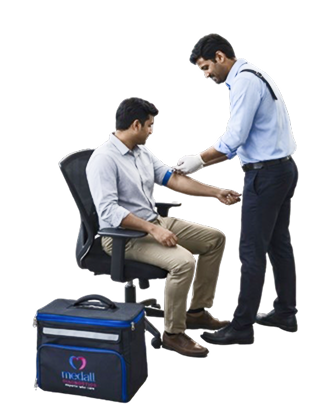
Book once, we handle the rest. Our certified phlebotomist arrives at your doorstep — your report is delivered within 24 hours.
Trusted by millions of Customers across South India — these are the tests our doctors recommend most.
Screens for anaemia, infections, and immune health