


Loading page…
The Urine Protein/Creatinine Ratio (UPCR) test measures the amount of protein being lost through the urine relative to creatini...
Also known as: Urine PCR Test · Spot Urine Protein:Creatinine Ratio · UPCR · Urinary Protein-to-Creatinine Ratio
Limited Offer | Best Price Guaranteed
Loading price…
Loading price…
*Inclusive of home collection charges


The Urine Protein/Creatinine Ratio (UPCR) test measures the amount of protein being lost through the urine relative to creatinine excretion — a highly accurate, non-invasive method for detecting kidney damage without requiring a 24-hour urine collection. A single spot urine sample is all that is needed. No fasting required.
Key benefits of this package include:
What Does the Protein / Creatinine Ratio — Urine (Spot Sample) Measure?
| Level / Result | Possible Interpretation |
|---|---|
| < 0.2 mg/mg (Normal) | Healthy kidney filtration — no significant protein loss |
| 0.2 – 0.5 mg/mg (Mild proteinuria) | Borderline — may require monitoring; common in early kidney disease |
| 0.5 – 3.5 mg/mg (Moderate proteinuria) | Significant kidney damage — likely CKD, diabetes-related, or hypertensive nephropathy |
| > 3.5 mg/mg (Nephrotic-range) | Severe protein loss — nephrotic syndrome, glomerulonephritis, advanced diabetic nephropathy |
Important Note: UPCR results must be interpreted by a qualified nephrologist or physician alongside kidney function tests (eGFR, creatinine), blood pressure, and clinical history.
UPCR vs. 24-Hour Urine Protein: Historically, a 24-hour urine collection was the gold standard for measuring protein excretion — but it is cumbersome and prone to collection errors. Multiple clinical studies have validated the Spot UPCR as an accurate surrogate for 24-hour proteinuria in most patients, making it the preferred test in routine clinical practice. Medall's NABL-accredited lab processes spot urine samples with precision instrumentation.

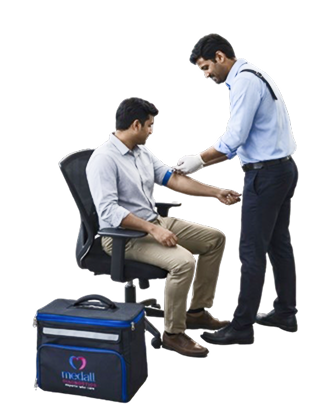
Book once, we handle the rest. Our certified phlebotomist arrives at your doorstep — your report is delivered within 24 hours.
Trusted by millions of Customers across South India — these are the tests our doctors recommend most.
Screens for anaemia, infections, and immune health