


Loading page…
The Arterial Blood Gas (ABG) test is a comprehensive panel that measures the levels of oxygen (O2), carbon dioxide (CO2), and p...
Also known as: ABG Test · Blood Gas Analysis · Arterial Blood Gas Analysis · ABG Panel
Limited Offer | Best Price Guaranteed
Loading price…
Loading price…
*Inclusive of home collection charges


The Arterial Blood Gas (ABG) test is a comprehensive panel that measures the levels of oxygen (O2), carbon dioxide (CO2), and pH in arterial blood — providing direct, real-time assessment of how well your lungs are oxygenating the blood and how effectively the body is maintaining acid-base balance. It is one of the most informative critical care tests for patients with respiratory or metabolic emergencies.
Key benefits of this package include:
What Does the Arterial Blood Gas (ABG) Test Measure?
| Level / Result | Possible Interpretation |
|---|---|
| pH < 7.35 (Acidosis) | Blood is too acidic — respiratory (high CO2) or metabolic (low HCO3-) cause |
| pH > 7.45 (Alkalosis) | Blood is too alkaline — respiratory (low CO2) or metabolic (high HCO3-) cause |
| Low PaO2 (< 80 mmHg — Hypoxaemia) | Inadequate lung oxygenation — pneumonia, COPD, PE, pulmonary oedema |
| High PaCO2 (> 45 mmHg — Hypercapnia) | Inadequate ventilation / CO2 retention — COPD, respiratory muscle failure |
| Low PaCO2 (< 35 mmHg — Hypocapnia) | Hyperventilation — anxiety, pain, early sepsis, compensation for metabolic acidosis |
| Low HCO3- (< 22 mEq/L) | Metabolic acidosis — DKA, lactic acidosis, renal failure, diarrhoea |
Important Note: ABG interpretation requires systematic analysis of all six parameters together — pH, PaO2, PaCO2, HCO3-, SaO2, and BE — and must always be performed by an experienced physician or intensivist in the context of the patient's clinical condition and oxygen therapy status.
ABG vs. Pulse Oximetry: Pulse oximetry (SpO2) measures the oxygen saturation of haemoglobin non-invasively and continuously — but it cannot measure CO2, pH, or bicarbonate. ABG gives the complete acid-base and gas exchange picture. In stable patients, pulse oximetry is sufficient for routine monitoring. ABG is ordered when precise assessment of ventilation, acid-base status, or oxygenation adequacy is needed — particularly in acute or complex clinical situations.

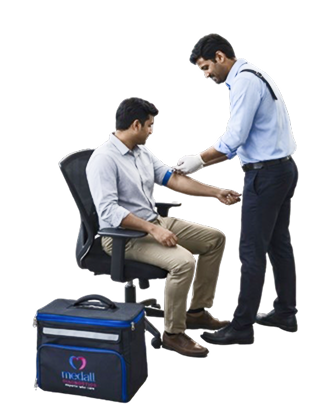
Book once, we handle the rest. Our certified phlebotomist arrives at your doorstep — your report is delivered within 24 hours.
Trusted by millions of Customers across South India — these are the tests our doctors recommend most.
Screens for anaemia, infections, and immune health